Acne Patch Market Saturation: How New Private Label Brands Find Their Niche
_画板-1-1-300x300.png)
Alps Medical
15 Years of Acne Patch Factory Manufacturing and Wholesale
Table of Contents
You have your samples approved. Your packaging is ready. Your Amazon listing is optimized. Then you scan the market and realize there are already dozens of hydrocolloid patch brands fighting for the same shelf space, the same keywords, the same retail buyers.This is the reality check every private label acne patch brand faces in 2026. The global anti-acne dermal patch market has grown to over $650 million, and the category shows no signs of slowing—but the density of competition has intensified. Hero Cosmetics got acquired for $630 million by Church & Dwight. COSRX dominates the K-beauty export channel. Mighty Patch owns the Amazon search results with 140,000 global ratings. Rael and ZitSticka have locked up specialty retail.Entering a saturated market is not impossible. It just requires a different strategy than entering an open category. This article covers how new private label brands find competitive positioning in a crowded acne patch market, what differentiation vectors actually move the needle, and where the remaining white-space opportunities exist.
Understanding the Saturation Landscape
Before you can outmaneuver competitors, you need to understand what you are actually competing against. The saturation in the acne patch category is not uniform—it varies by channel, price tier, and positioning.Channel saturation differs significantly. Amazon is the most crowded channel. A search for “acne patch” returns hundreds of listings, with the top results averaging 4-star ratings above 4.0 and review counts in the tens of thousands. Breaking into Amazon’s top organic results requires either aggressive review acquisition, advertising spend, or a product that genuinely fills a gap in the existing assortment. Specialty beauty retailers (Sephora, Ulta) have higher barriers but less saturation—these channels prioritize brand storytelling and clean ingredient positioning. Mass retailers (Target, CVS, Walgreens) occupy a middle ground: they need new products but are selective about velocity projections and category fit.Price tier saturation follows a predictable pattern. The $8–15 mass-market tier is the most crowded, populated by private label equivalents and established generic brands. The $18–30 premium tier has room but requires stronger differentiation signals—thicker hydrocolloid, active ingredients, or branded packaging. The $30+ ultra-premium tier (often microneedle or patented delivery systems) has the least competition but the smallest customer base.Geographic saturation varies. North America and Europe are mature markets with established players and strong private label growth. Asia-Pacific leads global demand, contributing over 45% of revenue, with South Korea and Japan setting the innovation agenda through K-beauty influence. Southeast Asia shows the fastest growth rates but lower average order values—important context for brands deciding where to launch first.The Three Vectors of Differentiation That Actually Work
Research across successful private label entrants reveals three primary differentiation vectors that translate into real competitive advantage. Most failed launches try to compete on price or product alone. Successful ones pick a vector and commit.1. Ingredient Sophistication
The base hydrocolloid formulation is largely commoditized. What differentiates is what you add to it. The market is moving beyond plain hydrocolloid toward active-enhanced patches:- Salicylic acid infusion. Targets users who want both protection and treatment in one step. Requires careful pH balancing and claim language review.
- Tea tree oil or centella asiatica. Appeals to the clean beauty segment seeking botanical alternatives to medicated options.
- Niacinamide or vitamin C. Positions for post-acne brightening—a growing use case as consumers layer patches into their broader skincare routines.
- Microneedle arrays. The premium differentiation. Dissolving micro-needles deliver hyaluronic acid and active ingredients beneath the skin surface. Several foundational microneedle patents are lapsing in 2026, opening this segment to new entrants.
2. Aesthetic Design and Brand Narrative
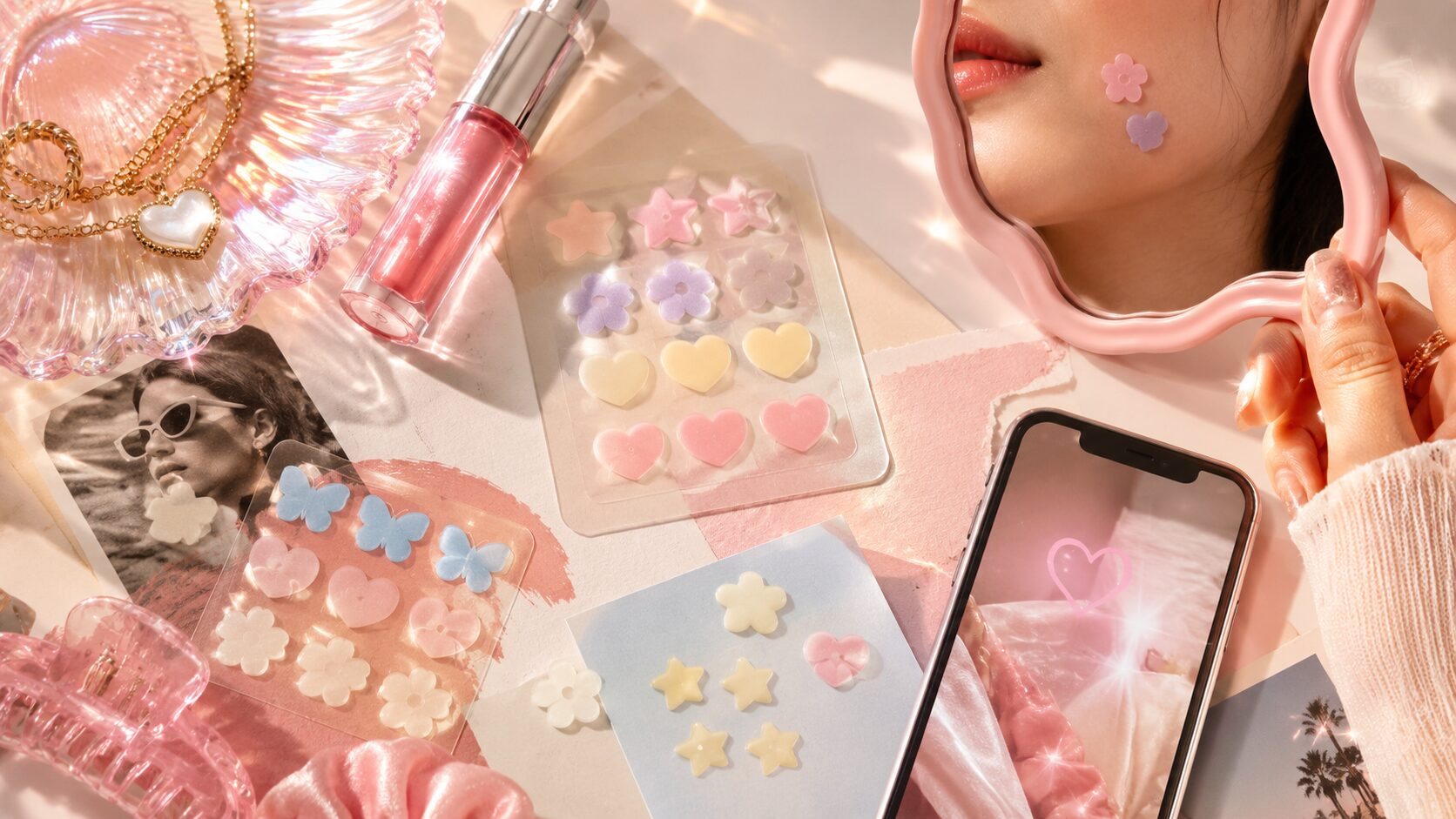
In a commodity category, packaging is the product. The rise of “visual skincare” and TikTok-driven purchasing means your packaging does marketing work before the customer ever tries the product:- Colored hydrocolloid. Beyond clear—tinted patches in beige, purple, or fun colors (star, heart shapes) appeal to Gen Z customers who treat skincare as self-expression.
- Packaging storytelling. Korean brands have set a high bar for packaging that communicates positioning immediately. Your pouch or box should answer: who is this for, what does it do, and why is it different—without requiring a paragraph of text.
- Visual satisfaction. Patches that show visible absorption (clouding hydrocolloid) generate user-generated content that amplifies organic reach. Consider how your patch performs visually when worn, not just when removed.
3. Sustainability Credentials
Environmental responsibility has moved from nice-to-have to baseline expectation, particularly in European markets and among younger demographics:- Biodegradable substrates. Traditional hydrocolloid patches are not biodegradable. Emerging eco-friendly formulations address this gap—but verify performance claims, as adhesion and absorption must meet customer expectations.
- Reduced packaging. Multi-sheet pouches versus boxes, recyclable materials, and minimal plastic wraps all contribute to sustainability positioning.
- Cruelty-free and vegan certifications. These certifications matter for specialty retail inclusion and for customers who prioritize ethical sourcing.
Finding Your Niche: A Practical Framework
Rather than trying to be everything to everyone, successful new entrants find a specific niche and own it. Here is a practical framework for narrowing your positioning:Step 1: Define Your Primary Customer Profile
Not “everyone with acne.” Be specific. Common viable niches in the acne patch category include:- Teenage first-time users. Price-sensitive, design-forward, need guidance on usage.
- Adult hormonal acne sufferers. Willing to pay premium for targeted solutions, often have established skincare routines.
- Sensitive skin customers. Prioritize gentle formulations, minimal ingredients, dermatologist-tested claims.
- Male grooming customers. An underserved segment in acne patches—23% male usage in South Korea signals growing opportunity elsewhere.
- Post-acne care users. Focus on dark spot reduction and skin recovery rather than active blemish treatment.
Step 2: Map Existing Competition Against Your Niche
For each potential niche, ask: who is already serving this customer, and what are they not delivering? If Mighty Patch owns the “reliable everyday protection” position, do not try to beat them at their own game. Find the adjacent position they have not claimed.Common unclaimed or underclaimed positions include: male-specific branding, extremely thin daytime patches (sub-0.2mm), patch-and-serum combo systems, travel-sized discrete options, and multifunctional patches targeting specific skin concerns beyond acne.Step 3: Test Your Positioning Before Full Launch
Launching with a single SKU (3,000–5,000 units) allows you to test whether your positioning resonates without overcommitting inventory. Key signals to watch:- Review sentiment. Do customers mention the specific differentiator you invested in? If you launched a tinted patch, do reviews reference color, visibility, or aesthetics?
- Return reasons. If returns cluster around a specific issue (adhesion, thickness, sizing), your differentiation may be interfering with core performance.
- Organic search terms. Are customers finding you through the keywords you expected, or are different search patterns emerging?
When Competitors React: Holding Your Position
Eventually, a competitor will launch a similar product. How you respond determines whether your niche is defensible:Do not panic-price. Competing on price in a saturated market erodes margin and signals that your differentiation is weak. If you are winning on ingredient quality, do not undercut on price—double down on the quality narrative.Accelerate iteration. If your niche is product-based (thickness, formulation, shape), release improvements faster than competitors can copy. Monthly minor updates keep your product feeling fresh and signal continuous improvement.Deepen channel relationships. If your niche is retail-specific (specialty beauty, pharmacy chains), invest in the relationship. Exclusive positioning or preferred vendor status creates barriers that product competitors cannot easily overcome.Expand the niche into a category. The goal is not to defend a single product—it is to own a positioning that lets you expand. A brand that owns “best patches for sensitive skin” can expand from patches to the broader sensitive skincare category.Frequently Asked Questions
Is the acne patch market too saturated for new private label brands?
The market is growing at 6–10% annually and remains fragmented. While Amazon is crowded, specialty retail and international markets still have room for differentiated products. Success requires choosing a specific niche rather than competing on generic positioning.What is the best differentiation strategy for a limited budget?
Packaging and brand narrative require the least capital investment but deliver strong differentiation. A distinctive visual identity, clear positioning language, and packaging that photographs well for social media can compete effectively against established brands without requiring reformulation or tooling investment.Should I compete on price in the mass-market tier?
Generally no. The mass-market tier has the thinnest margins and the most aggressive competitors. Unless you have a cost advantage from manufacturing scale, competing on price erodes your ability to invest in brand building and customer acquisition.How do I research competitor positioning before launching?
Review top-selling listings on Amazon, Sephora, and Target. Note their pricing, packaging design, ingredient claims, review themes, and brand storytelling. Identify gaps in their positioning—what need are they not addressing, what customer are they ignoring?Can I compete with established brands like Mighty Patch or COSRX?
You cannot outspend them on marketing or out-review them in the short term. You can out-position them by choosing a specific customer segment or use case they do not prioritize. The goal is to become the obvious choice for a specific niche rather than a weaker alternative to the dominant players.More Products
Ready to start your acne patch business? Whether you need custom formulas, private label packaging, or free samples, our team is just one message away.
*We takes your privacy very seriously. All information is only used for technical and commercial communication and will not be disclosed to third parties.
Let’s Create Your Custom Acne Patch Line
Take your skincare brand to the next level with our customized acne patch solutions. Every product we make is built on precision, performance, and partnership — helping you deliver real results that reflect your brand’s quality and care.
_画板-1-e1760947912226.png)
Ningbo Alps Medical Technology Co., Ltd. 15 Years of Acne Patch Factory Manufacturing and Wholesale
©2026All Rights Reserved.
Product
Quick Links
Get In Touch
Xingwen Future Technology City, No. 1001 Tanjiang North Road, Shounan Subdistrict, Yinzhou District, Ningbo City