Adding Acne Patches to an Existing Skincare Brand: When It Works and When It Backfires
_画板-1-1-300x300.png)
Alps Medical
15 Years of Acne Patch Factory Manufacturing and Wholesale
Adding Acne Patches to an Existing Skincare Brand: When It Works and When It Backfires
A skincare brand manager sits in a Monday meeting with a product list that already includes a cleanser, a serum, a moisturizer, and an SPF. The category numbers are solid. The brand identity is consistent. The packaging shelf reads like one family. Then someone says: “We should add acne patches.”
The move looks obvious on a spreadsheet. The risk is that the same logic produces products that feel bolted on. A patch that arrives in a pouch that shares no visual language with the rest of the brand. A patch positioned at a price point that undercuts the serum the brand spent two years building. A patch that the brand’s existing retail buyer refuses to place.
Adding acne patches to an existing skincare brand can work. It can also dilute the brand, confuse the shelf, and produce a SKU that the brand’s best customers ignore. The difference is in the specification decisions that happen before the first sample request leaves the inbox.
The Skincare Brand That’s Already Halfway There
Not every skincare brand should add acne patches. But some brands are closer to a natural line extension than they realize. A brand has an easier path to patches when:
- ✔ The customer already thinks about spot treatment. The brand sells a blemish serum or a tea-tree product. A patch extends the solution.
- ✔ The brand occupies a specific usage moment. Overnight patches fit a PM routine brand. Ultra-thin clear patches fit a makeup-prep brand.
- ✔ The visual identity translates to a flat format. Packaging that already works at small scale has an easier time making a patch look like it belongs.
- ✔ The price architecture has room. If the patch can be bundled into a kit or function as an entry product, the math works better.
Why the “Just Add a Patch” Brief Gets the Wrong Product
The most common line-extension patch brief reads: “Standard clear hydrocolloid patch, round, 12mm, 36-count, in a pouch with our logo.” That brief produces a generic product that competes on price, not on brand equity.
A better brief starts with the brand, answering questions like: What does this brand promise about how products feel? What does the packaging architecture communicate? What does the customer expect to pay? What usage claim territory does the brand already occupy?
The Specification Conversation Your Brand Has Already Answered
| Existing Brand Signal | What It Tells You About the Patch Specification |
|---|---|
| Serum texture: watery, lightweight | Patch format: ultra-thin, clear, invisible-positioned. |
| Serum texture: rich, occlusive | Patch format: overnight, stronger adhesion, visible absorption. |
| Brand is “gentle” or “barrier-support” | Plain hydrocolloid. Avoid ingredient-added positioning that contradicts simplicity. |
| Packaging: frosted glass, minimalist | Patch packaging: matte-finish box or pouch, clean layout. Match the minimalism. |
| Price anchor: $28-$48 (specialty/prestige) | Patch price: $14-$22. Avoid the $8 tier that undercuts brand perception. |
Three Patch Formats, Three Different Brand Stories
1. Plain Hydrocolloid: The “Trust Transfer” Play
The lowest-risk extension, judged on whether it performs: absorbs, stays on, comes off cleanly. If it falls off or leaves residue, the brand takes the hit.
2. Ingredient-Added Patch: The “Formulation Continuity” Play
If the brand sells a blemish serum, this is a natural extension. Requires testing ingredient compatibility with the hydrocolloid base and careful claim review.
3. Microneedle or Premium Format: The “Category Upgrade” Play
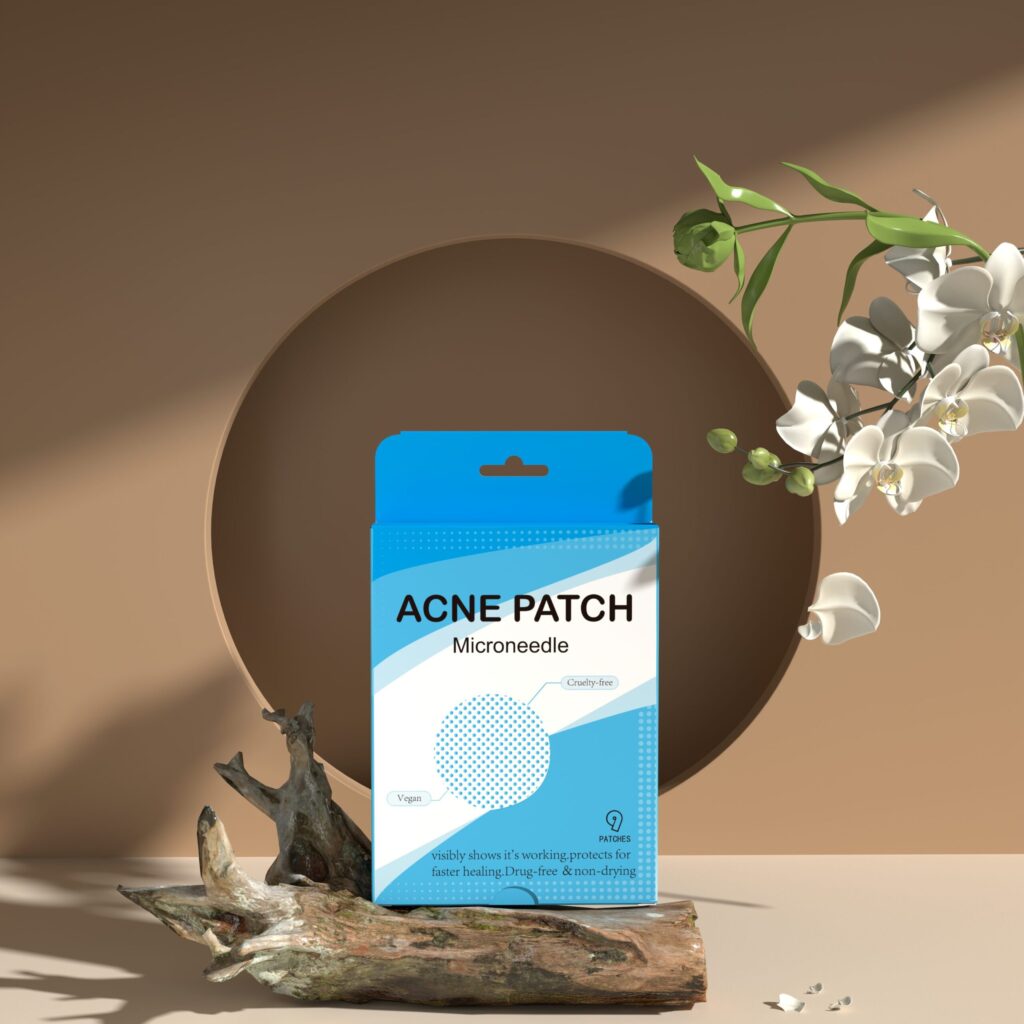
Works best for brands that already occupy a premium or technology-forward position. A mass-market brand adding a $22 microneedle patch creates a perception gap.
Packaging That Reads Like It Belongs on the Same Shelf
A brand that sells serums in frosted glass bottles, then ships patches in a glossy pouch with a different font, has created two different brand experiences. The packaging brief should answer:
- Format match: If the brand uses paper boxes, the patch should use a paper box (or box-insert-pouch combo).
- Color palette & Typography: Pull from the existing palette and match the exact typeface hierarchy.
- Inner presentation: A patch that arrives in a bare pouch delivers a different experience from a serum in a foam-fitted box with an insert card. Match the unboxing standard.
Frequently Asked Questions
Can I use my existing skincare brand’s manufacturer for acne patches?
Most skincare manufacturers do not produce patches unless they have a dedicated line. Managing two suppliers for one brand adds coordination complexity—confirm the internal team has bandwidth before committing.
What is a reasonable first-order quantity (MOQ)?
For a line extension test, a conservative first order is often in the range that stock patches with custom packaging can support. Fully custom shapes require higher MOQs. Confirm sample terms before placing an order.
Can I price my patch higher than generic patches because of brand equity?
Brand equity can support a modest premium if the patch is identical to competitors. If the patch specification is differentiated (custom shape, premium packaging, better adhesion), the premium can be larger.
What documentation should I have ready for a retail buyer?
Have a physical sample in final packaging (not a render). Prepare a one-page product sheet with specifications, wholesale price, and shelf-life info. Know your store placement recommendation.
What is the biggest mistake skincare brands make when adding patches?
Treating the patch as a SKU to capture category revenue rather than earning its place in the brand. The fix is to build the specification from the brand outward—starting with what the brand promises, then designing a patch that delivers it.
More News
Ready to start your acne patch business? Whether you need custom formulas, private label packaging, or free samples, our team is just one message away.
*We takes your privacy very seriously. All information is only used for technical and commercial communication and will not be disclosed to third parties.
Let’s Create Your Custom Acne Patch Line
Take your skincare brand to the next level with our customized acne patch solutions. Every product we make is built on precision, performance, and partnership — helping you deliver real results that reflect your brand’s quality and care.
_画板-1-e1760947912226.png)
Ningbo Alps Medical Technology Co., Ltd. 15 Years of Acne Patch Factory Manufacturing and Wholesale
©2026All Rights Reserved.
Product
Quick Links
Get In Touch
Xingwen Future Technology City, No. 1001 Tanjiang North Road, Shounan Subdistrict, Yinzhou District, Ningbo City