Your Acne Patch Line Sheet Is Missing What Retail Buyers Actually Read
_画板-1-1-300x300.png)
Alps Medical
15 Years of Acne Patch Factory Manufacturing and Wholesale
Your Acne Patch Line Sheet Is Missing What Retail Buyers Actually Read
You have an acne patch brand with Amazon reviews, a Shopify store that converts, and a supplier who delivers on time. A beauty distributor emailed you back. A regional chain buyer asked for your line sheet. You opened a template, dropped in product photos and wholesale prices, and sent it.
Then nothing. No follow-up. No meeting. No second email.
The line sheet you sent was the first thing that buyer saw about your brand. It was also the last. Retail buyers and beauty distributors see dozens of acne patch submissions a month. Most get rejected before the buyer reaches the second page — not because the product is wrong, but because the line sheet doesn’t answer the questions a wholesale buyer actually needs answered.
This article walks through what retail buyers, chain beauty buyers, and distributors evaluate when they open an acne patch line sheet. It covers the pricing architecture, product specifications, packaging presentation, and documentation decisions that determine whether your brand gets stocked or gets skipped. It is written for private label acne patch brand owners, Amazon sellers exploring wholesale, and beauty entrepreneurs preparing for their first retail buyer conversation.
Why Most Acne Patch Line Sheets Get Skipped
A retail buyer for a beauty chain or a distributor who supplies independent boutiques does not evaluate an acne patch line sheet the way a customer reads a product page. The customer reads benefits, images, and reviews. The buyer reads numbers, gaps, and risk.
The most common acne patch line sheet mistakes fall into a few patterns. First, the pricing doesn’t leave enough margin for the retailer. Second, the product specifications read like an Amazon bullet list without telling the buyer why a customer would pick this brand off a shelf. Third, the packaging looks like it was designed for a flat-lay Instagram photo, not for a store peg hook. Fourth, the line sheet asks the buyer to do extra work: missing UPCs, no case-pack details, no shelf-life information, and no compliance documentation.
What a Retail Buyer’s First Thirty Seconds Tells Them
A buyer’s scan of a new acne patch line sheet follows a consistent pattern. They look at the wholesale price first. Then they glance at the retail price or MSRP to calculate margin. Then they look at the product image to see whether the packaging reads like a brand or a commodity. Then they check whether the SKU count makes sense for shelf placement. Then they scan for the things that create extra work: missing case-pack quantities, no barcode, unclear shelf-life window, and the absence of any documentation mention.
If the scan reveals a product that costs too much for the category, looks like a generic private label patch in a pouch, offers one SKU, and has no shelf-ready packaging details, the buyer moves on. The rejection happens silently, in under thirty seconds, and you never hear why.
The Pricing Architecture That Won’t Get You Rejected
Pricing an acne patch for wholesale is different from pricing for Amazon or DTC. In wholesale, you set a wholesale price and the retailer or distributor layers their margin on top to arrive at a retail price. If your wholesale price doesn’t leave enough room, no amount of product quality will close the gap.
A typical beauty retail margin expectation ranges from 40% to 55% depending on the channel. A distributor who sells to independent boutiques may take 25-35% on top of your wholesale price before the store adds its own margin. If your acne patch costs the retailer $4.00 wholesale and the store needs to sell it at $9.99, the math works. If your wholesale price is $6.50 and the category ceiling is $9.99, the margin collapses and the buyer passes.
| Distribution Model | Typical Margin Layers | What Wholesale Price Must Support | Retail Price Ceiling |
|---|---|---|---|
| Direct to independent retailer | Retailer margin (40–55%) | COG + profit + freight allowance | Category ceiling sets limit |
| Distributor to boutiques | Distributor markup (25–35%) + retailer margin (40–50%) | Both margin layers before retail price | Lower wholesale price needed |
| Chain retail buyer | Retailer margin (45–55%) + deductions | COG + profit + deduction buffer | Chain-specific price bands |
| Amazon + wholesale hybrid | Amazon fees + wholesale margin | Channel-consistent pricing | MAP policy alignment critical |
These ranges are structural illustrations, not guarantees. Confirm specific numbers with each buyer before finalizing a pricing proposal.
Product Specifications a Retail Buyer Actually Notices
Retail buyers evaluate product specifications differently than Amazon shoppers. The specifications that matter most are the ones that affect shelf placement, customer satisfaction, and reorder consistency:
- ✔ Patch count versus retail price perception: A buyer comparing two brands at the same shelf price will choose the one with higher perceived value. If your pack offers less, the buyer needs a compelling reason to justify the gap (thinner edge, active ingredients, custom shape).
- ✔ Size mix that matches the customer: A pack with three or four sizes shows the brand understands how customers actually use the product.
- ✔ Adhesion performance: If your line sheet doesn’t mention adhesion testing or expected wear duration, the buyer fills that gap with doubt.
- ✔ Format differentiation: A retail buyer chooses products that earn their shelf space through visible differentiation. The line sheet should communicate that difference in the first product description line.
Packaging That Works on a Shelf, Not Just in a Flat Lay
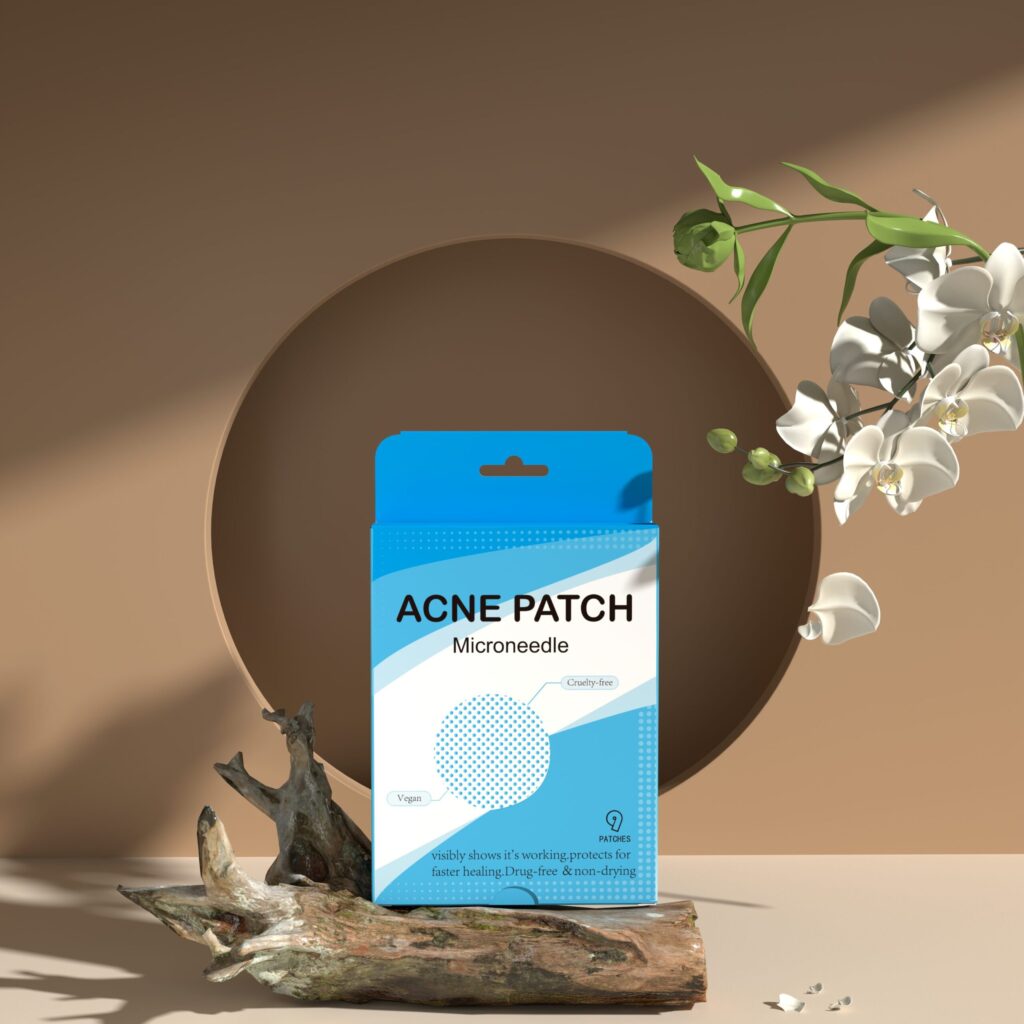
Most private label acne patch packaging is designed for an Amazon product photo. That same packaging on a retail shelf under fluorescent lights, viewed from three feet away, fails completely.
Retail-ready acne patch packaging needs to work in a different visual environment. The brand name and product category must be readable from shelf distance. The patch count should be visible without picking up the box. The front panel should communicate the format in a glance. The back panel needs room for required label copy, warnings, and barcode placement.
The line sheet should specify the packaging format (flat pouch with euroslot, rigid box, jar) and, when relevant, the case-pack quantity and master carton dimensions — because the buyer’s logistics team will ask for them before approving any SKU.
The Documentation Retail Buyers Expect
A retail buyer’s compliance team needs documentation before a product can be stocked. A brand that includes a one-page documentation readiness summary in the line sheet signals operational competence. A brand that hasn’t thought about any of this signals risk.
The documents a retail buyer commonly requests include:
- Product specification sheet (dimensions, materials, count, shelf life)
- Barcode/UPC assignment for each SKU
- Case-pack and master carton details
- Shelf-life information and delivery expectation
- Ingredient list and label copy
- Supplier documentation (test reports, COA, quality docs)
- Insurance certificates (if required)
For the US market, retail buyers may also ask about facility registration and product listing under MoCRA. Ask whether the supplier can support applicable MoCRA needs before presenting the brand to a retail buyer.
Frequently Asked Questions
What wholesale price should I set for my acne patch?
Build your wholesale price backward from the retail price ceiling of the category in your target channel, accounting for the retailer’s required margin — typically 40-55%. Confirm with each buyer rather than assuming one wholesale price fits all channels.
Do I need a different SKU for retail versus Amazon?
Channel-exclusive SKUs aren’t always necessary. What matters is that the retail buyer doesn’t find your brand selling at a lower price on Amazon in a way that undercuts their shelf price. A clear MAP policy and consistent retail pricing are critical.
What packaging format works best for retail shelves?
A flat pouch with a euroslot hang hole is common for peg-hook displays in mass retail. A rigid paper box conveys higher perceived value for specialty beauty. Confirm the retailer’s fixture type before committing to a packaging format.
How many SKUs do I need to approach a retail buyer?
A three-to-five SKU line is a practical starting range. Each SKU should serve a distinct shelf role — such as overnight, daytime, premium, and travel — rather than being the same product in different count sizes.
What shelf life should my acne patch have for retail acceptance?
Retail buyers typically expect beauty products to arrive with a minimum remaining shelf life of 18 to 24 months. Include the expected shelf life and the date format printed on the packaging in your line sheet.
This article is for informational purposes and does not constitute legal, regulatory, or compliance advice. Requirements vary by market and channel. Verify all requirements with qualified counsel or official regulatory guidance.
More News

Ready to start your acne patch business? Whether you need custom formulas, private label packaging, or free samples, our team is just one message away.
*We takes your privacy very seriously. All information is only used for technical and commercial communication and will not be disclosed to third parties.
Let’s Create Your Custom Acne Patch Line
Take your skincare brand to the next level with our customized acne patch solutions. Every product we make is built on precision, performance, and partnership — helping you deliver real results that reflect your brand’s quality and care.
_画板-1-e1760947912226.png)
Ningbo Alps Medical Technology Co., Ltd. 15 Years of Acne Patch Factory Manufacturing and Wholesale
©2026All Rights Reserved.
Product
Quick Links
Get In Touch
Xingwen Future Technology City, No. 1001 Tanjiang North Road, Shounan Subdistrict, Yinzhou District, Ningbo City